Παρασκευή 11 Ιανουαρίου 2013

The Siege of Constantinople


Artist conception of Arab forces that could have faced Roman troops.


The First Arab Siege of Constantinople (674 - 678) 


The first Arab siege of Constantinople is perhaps the single most important military action in the history of Western Civilization.  But it is a battle that little is known about.

The Umayyad Caliphate was fresh with a sting of victories and backed by the fervor of the new religion of Islam.  The "nations" of the West were basically non-existent.  If Constantinople had fallen at this point there would have been nothing to stand in the way of an Arab sweep up through the Balkans into central Europe.


Background

In the 7th Century the Eastern Roman Empire was under enormous military pressure on multiple fronts for decade after decade.  For the Romans, the 7th Century was almost non-stop war, invasions, counter invasions, amphibious operations, battles, sieges and sea battles.

The Empire was attacked by a series of enemies  -  Persians, Slavs and Arabs.  In the last of the Roman-Persian Wars (602 - 629 AD) the Empire had almost ceased to exist.  The great Roman Emperor Heraclius totally crushed the Persians reducing them to a state of internal anarchy and restored the Eastern Empire.


FIGHTING WARS ON THREE CONTINENTS
Roman Emperor Constantine IV and his court.  He organized the military and city for a siege of five years while fighting wars on multiple fronts over three continents (Africa, Europe and Asia).


The Arab Invasions  -  After the near death war with Persia the Empire badly needed peace, but that was not to be.  Islam now exploded on to the Middle East.  In late 620sMuhammad had already managed to conquer and unify much of Arabia under Muslim rule.

Starting in the 630s Arab armies fought an almost endless series of major engagements with Eastern Roman forces.  The slower moving and traditional Byzantine armies fought a losing battle against light and nimble Arab cavalry forces that out maneuvered them in the open country and deserts.  The results of the battles was the loss long held Roman provinces of Egypt, Cyrenaica, Arabia, Palestine, Mesopotamia, Armenia and Syria.

The pressure facing the Romans was not just military.  With every lost province the Empire was losing its tax base, food supplies, business income and population.  Areas that once supplied the Empire with bureaucrats, educators, soldiers, religious leaders and businessmen were now under the control of the Arab invaders.

VIDEO:  The Byzantine Army


The Late Roman Army

Constans II was the last Emperor to campaign in northern Italy and visit Rome as an Imperial possession.  He was also the last to exert real control over the Popes, arresting Martin I (649-653, d.655) and exiling him to the Crimea.

Under Constans the structure of the Roman Army was fundamentally changed to deal with the new circumstances of the Empire. As the traditional units, largely familiar from the 5th Century, fell back from the collapsing frontiers, they were settled on the land in Anatolia, to be paid directly from local revenues instead of from the Treasury, whose tax base from Syria and Egypt had disappeared. 


The areas set aside for particular units became the themes, which remained the military bedrock of Romania until the end of the 11th century and soon replaced the old Roman provinces as the administrative divisions of the Empire. 

Byzantine infantry re-enactor.

The Army of the East, driven out of Syria, was settled in the Anatolic Theme, where it would guard the obvious route for invasion or raids from Syria: the Cilician Gates through the Taurus Mountains. Although invasions and raids there would be, the Arabs never did secure any conquests beyond the Gates. Where the Army of the East in the Late Empire numbered about 20,000 men, the forces of the Anatolic Theme varied from about 18,000 in 773 to 15,000 in 899 [Warren Treadgold, Byzantium and Its Army, 284-1081, Stanford, 1995, p.67].

As the remnants of the Late Roman Army were settled on the land, there were also standing forces that accompanied the Emperor. There was already one such unit in the Late Empire, the Scholae. This would grow into a new Standing or Mobile Army, the Tagmata.  The Tagmata together numbered about 28,000 men, while the entire Army, Themes and Tagmata combined, added up to about 128,000 men [Treadgold, op.cit.]. 


This was less than half of the Augustan Army and not even a quarter of Constantine's; but considering that the Empire is reduced to the lower Balkans and Anatolia, it is proportionally still robust, especially in an Age when a paid military establishment was impossible in most of Europe. 

Despite this unprecedented disasters and loss of territories, the internal structures of the army remained much the same, and there is a remarkable continuity in tactics and doctrine between the 6th and 11th centuries.


Roman Empire military districts in 668AD.  The Empire had to defend North Africa, Italy
the Balkans and Asia Minor.
Click graphic to enlarge.


Three of the four sides of the city of Constantinople were the ocean.  Here are the sea walls of the city.
Only a small number of enemy troops could land at one time, and they would be vulnerable to Byzantine
attack with arrows, boiling oil, rocks etc.


Siege of Constantinople

The five year siege of this great city was the most important battle in the history of the Western world.  If the Arab armies had broken the Romans at Constantinople nothing would have stood in their path to invade Europe.

We know so very, very little about this battle.  But what we can do is use the information we do have to extrapolate what might have happen based on military history in general.

Many historians in the last few centuries have taken their cue from Edward Gibbon in hisDecline and Fall of the Roman Empire.  Gibbon would often look down on the Byzantines as pretend Romans.  He would long for the good old days of the Legion.

Gibbon savagely attacked "the courage and vigilance of the reigning emperor, who disgraced the name of Constantine."  Gibbon's insults are not real history.  The Emperor Constantine IV organized the Empire for multiple major military operations at the same time including the great siege of the capital itself.  That implies a major degree of planning, command and control with a large professional military and civil service.

Multi-Front Warfare:  There was active warfare in North Africa with Arab invasions slowly taking over Roman provinces.  The Slavs were (as usual) yet again invading the Balkan provinces.  Arab armies had just conquered Roman Armenia and threatened the rest of Asia Minor.  More Arab armies were in Syria pinning down Roman units and pushing up the coast of Anatolia.  And now a massive naval invasion force is heading to Constantinople itself.

To say that Constantine IV had his hands full is an understatement.

Troop Deployment:   The Byzantine historian Treadgold says the strength of the Roman Army at this point was 109,000 men under arms.  We cannot be sure how many troops were assigned to Constantinople for the coming siege.  What we can do is to work backwards from the 109,000 number and subtract units that appear to have been assigned to other areas.  (see map graphic above.)

  • 15,000 troops.  Army of Africa, Exarchate of Africa.
  • 20,000 troops.  Army of Italy, Exarchate of Ravenna.
  • 20,000 troops.  Army of the East, Anatolic Theme.
  • 15,000 troops.  Army of Armenia, Aramenic Theme.

These units total 70,000 men more or less, but it is all guess work.  The important point is these units are based far from Constantinople itself and cannot be easily or rapidly re-deployed to other areas.  If troops were taken from the Army of the East then that part of the frontier would be weakened in the face of enemy forces and invite invasion on yet another front.

So it might be safe to say that in the greater Constantinople area the Emperor might have available to him in the range of 39,000 troops.  Perhaps more men might have been available through raising additional civilian militias and volunteer units.  But a certain number of these troops would have to be pealed away from defending Constantinople in order to defend other cities and strategic points in the area.

For example, when the siege of Constantinople was raised Constantine rushed to go to the relief of Thessalonika, which was still under siege from the Slavs.  So some units must have been assigned garrison duty in the Balkans. 

But a Slavic siege going on at the same time as an Arab siege makes you wonder if there was co-ordinated action between Arab and Slav forces.  Maybe the Slavs were just taking advantage of the situation.  Recorded history is silent on a possible alliance.

I can find no real information on the numbers of Arab troops transported to the area for the siege.  If you look at military history in general those conducting a siege usually outnumber those inside the walls to a large degree.  If not then those inside could easily break out or bring in supplies. 

If the Romans had 25,000 plus troops inside the city it is fair to say the Arabs would not have shown up with less.  I would give the Arabs a force of 40,000 or more troops as the minimum needed to maintain a siege.  In the 2nd siege carried out 40 years later the Arabs had 80,000 or more men.  So it is possible that the 40,000 estimate for the 1st siege is too low.

Romans    -    25,000 or more
Arabs       -    40,000 maybe much higher

Naval Forces  -  There are no numbers on the Arabs ships.  The Romans used over 1,100 ships to transport a large invasion force of tens of thousands of troops and their supplies in the attack on Carthage in 468 AD.  It is reasonable to think that the Arabs might use a fleet of about the same size or less.

The Romans had almost their entire fleet crushed in 655 in "The Battle of the Masts."  With so many provinces lost and constant wars, the money available for national defense would have been tight.  What fleet the Romans had available they kept close to the city.


The Theodosian Walls of Constantinople, which proved impregnable during the siege. (Byzantium 1200)


The Battle Begins

In 674, the Arabs launched the long awaited siege of Constantinople.  The great fleet that had been assembled set sail under the command of Abd ar-Rahman before the end of the year; and during the winter months some of the ships anchored at Smyrna, the rest off the coast of Cilicia.  Additional squadrons reinforced the forces of Abd ar-Rahman before moving on.  The naval forces of the Umayyads passed through the unguarded channel of the Hellespont about April 674.

But the besiegers had formed an insufficient estimate of the strength and resources of Constantinople.  Simply the Arabs had no idea what they were going to face.  The size of Constantinople and its massive defenses had shocked visitors for centuries on end.

Now a perhaps fairly lightly armed Arab army and fleet would have shown up with no idea on how to break into this fortress defended by a system of multiple walls and the ocean itself.

The Arabian fleet cast anchor, and the troops were disembarked near the palace of Hebdomon, seven miles from the city. From the first light of dawn till the evening over a period of many days the Arab infantry attacked the city's land walls from the Golden Gate going far to the east.  The reports say that the warriors in front were pushed forward toward the walls by the weight of the troops piling up behind them.

The solid and lofty walls were guarded by numbers and discipline: the spirit of the Romans was rekindled by the last danger to their religion and empire. The fugitives from the conquered provinces more successfully defended the city than they had at the sieges of Damascus and Alexandria. 

VIDEO:  Greek Fire


Greek Fire:  Just prior to the siege, a Syrian Christian refugee named Kallinikos (Callinicus) of Heliopolis had invented for the Byzantine Empire a devastating new weapon that came to be known as "Greek fire".   Its ingredients are a much debated topic, with proposals including naphtha, quicklime, sulphur, and niter. What set the Byzantine usage of incendiary mixtures apart was their use of pressurized siphons to project the liquid onto the enemy.

The first reports of the use of Greek Fire appears to have been on the Arab infantry trying to break through the land walls.  It is said they "were dismayed by the strange and prodigious effects of artificial fire."

This firm and effectual resistance by the Romans discouraged the Arab forces that were used to quick victories with fast moving cavalry tactics.  Arab soldiers came looking for fast loot and slaves.  The Arab leadership needed to keep the troops happy.  They diverted their arms to the more easy attempt of plundering the European and Asiatic coasts of the Propontis. 

After controlling the sea from the month of April to that of September, on the approach of winter they retreated eighty miles from Constantinople, to Cyzicus, in which they had established their magazine of spoil and provisions.

For the six following summers the Arabs repeated this same pattern of attack and then retreat for the winter months. 

Then in 677 after three years of siege, the Byzantine navy utilized Greek Fire to decisively defeat the Umayyad navy in the Sea of Marmara.  The naval victory that the Byzantines won ensured that the city could be re-supplied by sea.  Meanwhile, the Arab forces were beset with starvation in winter.

Each year had seen a gradual abatement of Arab hope and vigor.  Finally after years of naval defeats and a fruitless siege the Arab forces broke camp in 678 and returned home.

It was said that 30,000 Arabs had died.  Byzantine casualties were thought to be several thousand.

Peace 

The victory for the Romans was total.

As the Arabs withdrew from Constantinople they were almost simultaneously defeated by the Romans on land in Lycia in Anatolia.

Byzantine historian J.B. Bury says the Arab fleet was caught in a storm and dashed on the rocks off the southern coast of Turkey near modern day Antalya.  What was left of the Arab fleet was destroyed by a Roman fleet operating from the Byzantine Theme of Cibyraiot off the southern coast of Asia minor.

In addition the Muslims of Syria came under attack by Christian irregular troops orarmatoli operating in the Taurus Mountains.  The armatoli attacked and plundered Muslims from Asia Minor all the way south to Mount Lebanon.  Reinforced by Christian Syrians and Slavs they grew in power raiding as far as Jerusalem and helping Christian refugees escape to the north away from Islam.     

These losses at Constantinople, of the fleet and setbacks on land forced the Umayyads to seek a truce with Constantine.  The Roman Ambassador was received in Damascus by a general council of emirs.  A peace of thirty years was signed.   The Arabs evacuated the islands that they had captured in the Aegean.  In addition they paid the Romans an annual tribute consisting of fifty slaves, fifty horses and 3,000 pounds of gold.  

With the siege raised, Constantine could march to the relief of Thessalonika which was under siege from the Slavs.

The Arab invasions has finally been checked by Roman arms.  Europe was saved from an invasion they had no way to counter.

One artist's view of Greek Fire being used by the Byzantines.
(gilbert1986.blogspot.com)

The horror of burning to death by Greek Fire would have given the Byzantines a huge edge in battle.
(gilbert1986.blogspot.com)

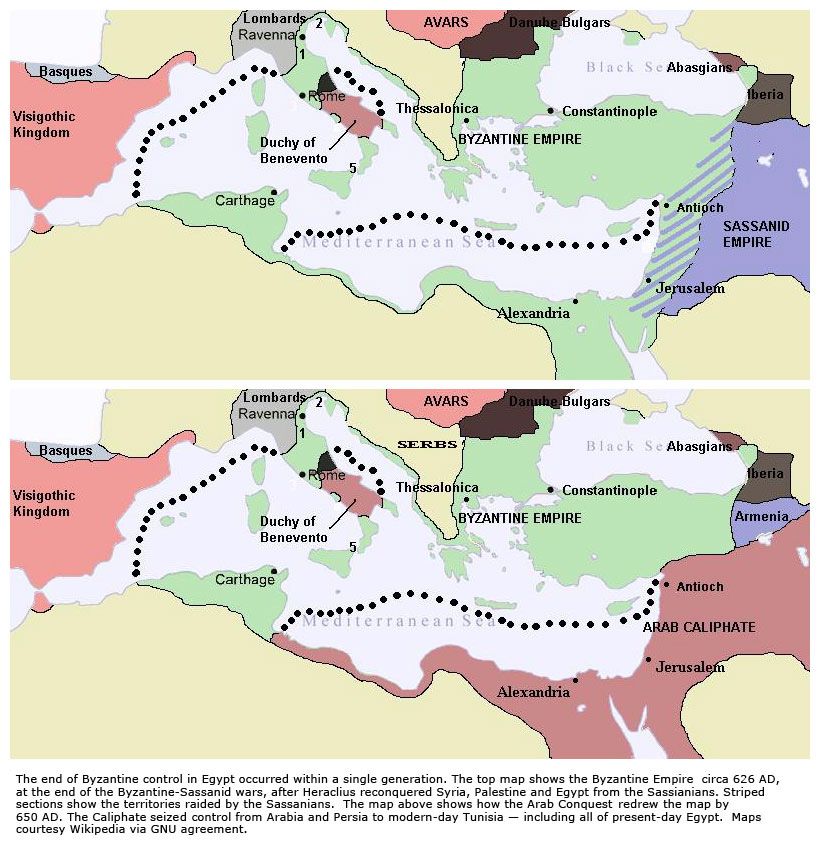
Two maps showing the Eastern Roman Empire.  Top map shows the Empire after the defeat of
the Persian Empire.  The bottom map shows the Arab conquest of Egypt, Syria and Palestine.
Click on map to enlarge.


Constantinople in the Byzantine period.
Click image for full size map.

Τετάρτη 9 Ιανουαρίου 2013

Τα πραγματικά αίτια του Σχίσματος.

Α' Ράιχ


Ένα σπουδαίο κείμενο από ένα σπουδαίο άνθρωπο. Η σκοτεινή σαγήνη για κυριαρχία, που έκανε ένα άξεστο και βάρβαρο λαό να φέρει την αρχή του κακού. Διαβάστε το και μάθετε, πως η ζήλια και ο φθόνος των Φράγκων στο πρόσωπο των προγόνων μας γέννησε τη μεγαλύτερη καταστροφή για την Οικουμένη. Αν και στο κείμενο δεν το αναφέρει, αυτό που θα διαβάσετε παρακάτω είναι επιπλέον η γέννηση του Πρώτου Ράιχ. Γ.Θ Από το περιοδικό «Εν Συνειδήσει» Έκδοση της Ιεράς Μονής Μεγάλου Μετεώρου. Δεκέμβριος 2006. Η γέννησις του Φραγκικού Πολιτισμού περιγράφεται εις επιστολήν του Αγίου Βονιφατίου προς τον Πάπα της Ρώμης Ζαχαρίαν (natione Graecus) το 1741. Οι Φράγκοι είχον διώ­ξει όλους τους Ρωμαίους επισκόπους από την Εκκλησίαν της Φραγκίας και είχαν διορίσει τον εαυτόν τους ως τους επισκόπους και ηγουμένους της Γαλλίας. Ήρπασαν την περιουσίαν της Εκκλησίας και την εχώρισαν εις τιμάρια, των οποίων την επικαρπίαν διένειμαν ως Φέουδα, συμφώνως προς τον βαθμόν που κετείχε έκαστος εις την πυραμίδα της στρατιωτικής ιεραρχίας. Αυτοί οι Φράγκοι επίσκοποι δεν είχον Αρχιεπίσκοπον και δεν είχον συνέλθει εις σύνοδον στα 80 χρόνια από τότε που κατέλαβαν την ιεραρχίαν. Συνήρχοντο δια τα εθνικοεκκλησιαστικά θέματα μαζί με τους βασιλείς και λοιπούς οπλαρχηγούς συναδέλφους τους. Κατά τον Άγιον Βονιφάτιον, ήσαν «αδηφάγοι λαϊκοί, μοιχοί καί μέθυσοι κληρικοί, οι οποίοι μάχονται εις τον στρατόν με πλήρη πολεμικήν εξάρτησιν και με τας χείρας των σφάζουν χριστιανούς και ειδωλολάτρας». Οι Φράγκοι καταδίκασαν τους Ανατολικούς Ρωμαίους ως «αιρετικούς» και «Γραικούς» ήδη το 794 και το 809, δηλαδή 260 χρόνια ενωρίτερα από το λεγόμενο σχίσμα το 1054. Οι Φρά­γκοι είχαν αρχίσει από το 794 να αποκαλούν τους ελευθέρους Ρωμαίους με τα ονόματα «Γραικοί» και «αιρετικοί» με σκοπό οι υπόδουλοι Δυτικοί Ρωμαίοι να ξεχάσουν βαδμηδόν τους συναδέλ­φους τους εις την Ανατολήν. Οι Φράγκοι διήρεσαν συγχρόνως τους Ρωμαίους Πατέρες σε λεγομένους Λατίνους και Γραικούς και εταύτισαν τον εαυτόν τους με τους λεγομένους Λατίνους Πατέρες. Έτσι εδημιούργησαν την ψευδαίσδησιν ότι η Φραγκο-Λατινική τους παράδοσις είναι ένα συνεχόμενον μέρος της παραδόσεως των Λατινοφώνων Ρωμαίων Πατέρων. Γενόμενοι οι Δυτικοί Ρωμαίοι δουλοπάροικοι του Φραγκο-Λατινικού Φεουδαλισμού έπαυσαν να παράγουν επισκόπους και ηγουμένους και ολίγους γνωστούς αγίους. Κατά την διάρκειαν των ετών 1009 με 1046 οι Φραγκο-Λατίνοι αυτοκράτορες της Φραγκίας ίδρυσαν τον σημερινό Παπισμό σε δύο στάδια. πρώτα εγκατέστησαν δια πρώτη φορά αιρετικούς Ρωμαίους πάπες της Ρώμης. Δηλαδή οι εν λόγω πάπες απέκτη­σαν τους θρόνους τους υπό τον όρον ότι αποδέχονται την προσθήκην του Filioque στο Σύμβολον της Πίστεως. Το δεύτερον στάδιον άρχισε το 1046 όταν ο Φράγκος Αυτοκράτωρ Ερρίκος Γ' (1049-1056) αντικατέστησε τον Ρωμαίον πάπα Γρηγόριον ΣΤ' (1045-1046) με τον Φραγκο-Λατίνον πάπα Κλήμεντα Β' (1046-1047). Από τότε μέχρι σήμερον οι πάπες είναι σχεδόν όλοι Τεύτονες ανήκοντες στην τάξιν των Φραγκο-Λατίνων ευγενών κατα­κτητών της Δυτικής Ρωμαιοσύνης. Επομένως το λεγόμενο σχίσμα μεταξύ Εκκλησιών Δύσεως και Ανατολής δεν έγινε μεταξύ Δυτικών και Ανατολικών Ρωμαίων, αλλά μεταξύ των Φράγκων κατακτητών των Δυτικών Ρωμαίων και των ελευθέρων Ρωμαίων της Δύσεως και της Ανατολής. Μάλιστα το 1054 οι Κέλτες και οι Σάξωνες της Αγγλίας και οι Ρωμαίοι της Αραβοκρατουμένης Ισπανίας και Πορτογαλίας ήταν Ορθόδοξοι. Ήδη από τον 8ον αιώνα άρχισαν οι Φράγκοι να κατηγορούν τους ελευθέρους Ρωμαίους της Κωνσταντινουπόλεως Νέας Ρώμης ως «αιρετικούς» και «Γραικούς» στα θέματα των εικό­νων και του Filioque. Οι Φράγκοι ήταν τότε τελείως βάρβαροι και αγράμματοι, όπως είδαμεν. Οι τότε Ρωμαίοι πάπες απλώς διεμαρτυρήθησαν, αλλά ακόμη δεν κατεδίκασαν τους Φράγκους από φόβον αντιποίνων με σφαγές μάλιστα, όπως μας πληροφορεί ο άγιος Βονιφάτιος το 741. Ίσως ήλπιζαν οι Ρωμαίοι ότι θα ημπο­ρούσαν εν καιρώ να επιβληθούν στους Φράγκους όπως κάμνει κανείς επάνω σε πείσμονα παιδιά. Αλλά οι Ρωμαίοι της Πρεσβυ­τέρας Ρώμης, αλλά ούτε και οι Ρωμαίοι τής Νέας Ρώμης, ούτε καν υποπτεύθηκαν ότι οι Φράγκοι από σκοπού προκαλούσαν μόνιμον σχίσμα ως μέρος της αμυντικής τους στρατηγικής κατά της Ρωμαϊκής Αυτοκρατορίας και των σχεδίων τους δια παγκόσμιον κυριαρχίαν. Οι Ρωμαίοι πάπες δεν είχαν άλλην εκλογήν από το να ανεχθούν την Φραγκικήν κυριαρχίαν με σκοπόν να βοηθήσουν με την σύνεσίν τους τους υποδούλους αδελφούς τους και να εξασφαλίσουν την σχετικήν ελευθερίαν του Πατριαρχείου τους και αυτήν των Ρωμαίων πολιτών της Παπικής Ρωμανίας, δηλα­δή του Παπικού Κράτους. Με την εμφάνισιν των Ψευδο-Ισιδωρείων Δια­τάξεων περί το 850 οι Ρωμαίοι Πάπες άρχισαν να αισθάνωνται αρκετά ισχυροί. Απαίτησαν δυναμικά πλέον από την Φραγκικήν ηγεσίαν να δεχθούν 1) πιο πολιτισμένους κανόνες καλής συμπεριφοράς έναντι της υποδούλου Ρωμαιοσύνης και 2) την απαλλαγήν της Φραγκικής ιεραρχίας από τους Φράγκους ηγεμόνες και την υποταγήν της εις τον Ρωμαίον Πάπα της Ρώμης. Μέσα στα πλαίσια αυτά ο Ρωμαίος Πάπας Ιωάννης Η' έλαβε μέρος στην Η' ΟΙκουμενικήν Σύνοδον του Μεγάλου Φωτίου το 879 στην Κων/πολιν Νέαν Ρώμην, η οποία κατεδίκασε τας Φραγκικάς αιρέσεις περί εικόνων και του Filioque, χωρίς να κατονομάση τους εν λόγω αιρετικούς από φόβον να μη κινδυνεύη το έργον που άρχισε το 850. Αλλά αι προσπάθειαι βάσει των εν λόγω Διατάξεων έφεραν τελικά το αντίθετον αποτέ­λεσμα. Οι Φραγκο-Λατίνοι αντέδρασαν δυνα­μικά στην δημοφιλίαν των Διατάξεων αυτών. Άρχισαν να σχεδιάζουν και να εφαρμόζουν τα σχέδια τους δια την εκδίωξιν των Ρωμαίων από την εκκλησιαστικήν και την πολιτικήν εξουσίαν της Παπικής Ρωμανίας και την αντικατάστασιν των Ρωμαίων Παπών από Φραγκο-Λατίνους Πάπες. Οι Φραγκο-Λατίνοι άρχισαν την τελικήν τους επίθεσιν κατά της ελευθερίας, της Ορθοδοξίας και της Ρωμαϊκότητος του Πατριαρχείου της Πρεσβυτέρας Ρώμης κατά το 973 μέχρι το 1003. Ολοκλήρωσαν την εκδίωξιν του Ορθοδόξου δόγματος το 1009-1012 μέχρι το 1046. Τελικά αφάνισαν πλήρως την Ρωμαϊκότητα του Πατριαρχείου της Ρώμης το 1046 αφού την κατέλαβαν οι Φραγκο-Λατίνοι πάπες. Δια τούτο από την εποχήν αυτήν οι Ορθόδοξοι Ρωμαίοι ονομάζουν τον πάπα αιρετικόν, Φράγκον καί Λατίνον καί την εκκλησίαν του Φραγκικήν καί Λατινικήν. Παραταύτα οι καθηγηταί των Θεολογικών Σχολών της Χάλκης, Αθηνών και της Θεσσαλονίκης βάπτισαν τον Φραγκο-Λατίνον πάπα με το όνομα «Ρωμαί­ον» και την εκκλησίαν του «Ρωμαϊκήν». Τούτο διότι οι Φραγκο-Λατίνοι Πάπες συνέχισαν να χρησιμοποιούν τα Ρωμαϊκά ονόματα των Ρωμαίων παπών γενόμενοι πάπες, ως και ονό­ματα Ρωμαίος πάπας και Ρωμαϊκή Εκκλησία, δια να συνεχίζουν οι υπόδουλοι Δυτικοί Ρωμαί­οι να νομίζουν ότι έχουν ακόμη τον εθνάρχην τους στην Ρώμην. Γενόμενοι οι Νεο-Έλληνες και αυτοί υπόδουλοι στην Φραγκο-Λατινικήν παράδοσιν ονομάζουν και αυτοί τον πάπα με Ρωμαϊκά ονόματα. Από όλα τα ανωτέρω σημειωθέντα φαίνεται σαφώς ότι ο καθορισμός του σχίσματος το 1054, εντός της πλαστογραφημένης διακρίσε­ως μεταξύ «Ανατολικών Γραικών» και «Δυτικών Λατίνων», δεν είναι σωστός. Το σχίσμα άρχισε το 794 ως καλά σχεδιασμένο αμυντικό και επιθετικό κατασκεύασμα των βαρβάρων και αγραμμάτων Φράγκων. Το 1054 ήτο μόνον μία από τας μετέπειτα εκδηλώσεις ενός σχί­σματος, το οποίον ήδη υπήρχε από την εποχή που οι Φράγκοι απεφάσισαν το 794 να προκα­λέσουν σχίσμα με τους ελευθέρους Ρωμαίους που δια πρώτην φοράν ονόμασαν «Γραικούς» και «αιρετικούς» δια λόγους πολιτικούς και στρατιωτικούς. Η Εκκλησία της Πρεσβυτέρας Ρώμης ηγωνίσθηκε ηρωικά να παραμείνη ηνω­μένη με την Νέαν Ρώμην μέχρι το 1009. Από το 794 μέχρι τα μέσα του 20ου αιώνος οι Φράγκοι, οι Φραγκο-Λατίνοι και το Βατικανό, ουδέποτε παρεξέκλιναν από την γραμμήν τους ότι οι Ανατολικοί Ρωμαίοι είναι «Γραικοί» και «αιρετικοί». Τούτο ήτο τόσον έκδηλον στην νεανική ηλικία του γράφοντος όταν εσπούδαζε στο γυμνάσιον της Νέας Υόρκης. Στα παπικά βιβλία Απολογητικής οι Ορθόδοξοι περιεγράφοντο ως αιρετικοί και χωρίς αγίους και θαύματα. Έτσι ισχυρίζοντο ότι οι τελευταίοι Πατέρες της Εκκλησίας των Ορδοδόξων ήταν οι Άγιοι Ιωάννης Δαμασκηνός (περίπου 675-749) και Θεόδωρος Στουδίτης (759-826). Επίσης οι Φραγκο-Λατίνοι και ο Παπισμός τους συνέχισαν τας κατακτήσεις τους που πάντοτε συνοδεύοντο από την εξόντωσιν ή εκδίωξιν των Ορθοδόξων επισκόπων και την υποδούλωσιν των πιστών δια της μεταβολής τους στην κατάστασιν δουλοπαροίκων με την πλήρη αφαίρεσιν της γεωκτησίας τους. Αυτό δεν το έκαναν ποτέ ούτε οι Άραβες και ούτε οι Τούρκοι Μουσουλμάνοι. Αλλά ακόμη μέχρι αρχάς του 20ου αιώνος το Βατικανό ενεργούσε κατά τον ίδιον τρόπον. Το 1923 η Ιταλία απέκτησε από την Τουρκίαν τα Δωδεκάνησα με την Συνθήκην της Λωζάνης. Το Βατικανό έδιωξε όλους τους Ορθοδόξους επισκόπους και τους αντικατέστησε με Φραγκο-Τοσκάνους και Λογγοβάρδους που από το 1870 είχαν υποδυθεί την ταυτότητα του μέχρι τότε ανυπάρκτου Ιταλικού έθνους. Ήλπιζε το Βατικανό ότι οι Ορθόδοξοι πιστοί θα αποδε­χθούν τελικά κληρικούς χειροτονημένους απ' αυτούς τους επισκόπους του δια να μη μείνουν χωρίς κληρικούς και μυστήρια. Η κατάστασις άλλαξε όταν τα Δωδεκάνησα ενώθηκαν με την Ελλάδα το 1947 και επανήλθαν εις τας θέσεις τους οι επίσκοποι του Οικουμενικού Πατριαρ­χείου της Νέας Ρώμης Κων/πόλεως. Αλλά κατά τα μέσα του 20ου αιώνος τούτου το Βατικανό εγκαινίασε μίαν πρωτότυπον τακτικήν. Περιέργως ανεγνώρισε τα μυστήρια της Ορθοδόξου Εκκλησίας. Όταν έγινε η Βατικάνειος πράξις αυτή μέσω της Συνόδου του Βατικανού Β' (1962-1965) ορισμένοι Ορθόδοξοι κατάλαβαν ότι πρόκειται δια παγίδα. Άλλοι εχάρηκαν. Μερικοί μάλιστα «Ορθόδοξοι» στο εξωτερικό ενόμισαν ότι η χειρονομία αυτή έδω­σε κύρος όχι μόνον στα μυστήρια, αλλά και στην ταυτότητά τους ως θρησκευτική ηγεσία. Εν συνεχεία το Φανάρι και το Βατικανό προέ­βησαν την 7η Δεκεμβρίου 1965 σε κοινήν άρσιν των αναθεμάτων του 1054. Δια το Βατικανό τούτο απετέλεσε πράξιν μυστηριακής κοινωνίας βάσει της υπ' αυτού αναγνωρίσεως των Ορθοδόξων μυστηρίων. Εξ' επόψεως Ορθοδόξου ήταν μία πράξις του Φαναρίου δια την οποίαν κινδυνεύει να χάση το εντός της Ορθοδοξίας προεδρείον του αν αποδειχθή ότι με την πράξιν αυτήν αναγνώρισε ή ανέχεται ή συμφωνεί με τας αιρέσεις των 13 Φραγκο-Λατινικών «Οικουμενικών Συνόδων». Αν ήτο μία απλή πράξις καλής θελήσεως δια να διευκολυνθή ο διάλογος που επρόκειτο τότε να αρχίση, έχει καλώς. Πάντως όσον άφορα στο Βατικανό το θέμα έχει ως εξής. η μεταβολή της τακτικής του Βατι­κανού από «πόλεμο» και «διάλογο» σε τακτική «αναγνωρίσεως των Ορθοδόξων μυστηρί­ων» είναι μία πραγματικότης. Αλλά το ότι το Φανάρι αμέσως ανταπέδωσε με την από κοινού μετά του Βατικανού σύγχρονον άρσιν των ανα­θεμάτων του 1054 την 7.12.65 σημαίνει ότι η κοινή πράξις αυτή ήτο αποτέλεσμα μυστικών συνεννοήσεων μεταξύ των δύο. Δηλαδή η πρά­ξις ήτο μονόπλευρος μόνον με την έννοιαν ότι δεν συμμετείχε ολόκληρος η Ορθοδοξία, αλλά μόνον το Φανάρι. Το ότι σχεδόν σύσσωμα χαι­ρέτησαν την πράξιν οι υπόλοιποι Ορθόδοξοι ως πράξιν καλής θελήσεως, δεν έχει καμμίαν δογματικήν σημασίαν. Αι αιρέσεις του Βατικα­νού παραμένουν. Τι επιδιώκει το Βατικανό θα εξαρτηθή από τι θα κάνη με τας (13) Φραγκο-Λατινικάς Οικου­μενικάς του Συνόδους που προσέθεσε στας 7 Ρωμαϊκάς Οικουμενικάς Συνόδους μαζί με την Σύνοδον του 869 που καθήρεσε τον Μέγαν Φώτιον. Μάλιστα θεωρεί την Σύνοδον του 869 κατά του Μεγάλου Φωτίου ως την Η' Οικουμενικήν της Σύνοδον. (Εκ της μελέτης του π. Ιωάννου Ρωμανίδου "Ορθόδοξος και Βατικάνειος Συμφωνία περί Ουνιτισμού" δημοσιευθείσης εις τον τόμον "Καιρός", αφιέρωμα στον καθηγητή Δαμιανό Δόικο, Θεσσαλονίκη 1995).

Κυριακή 6 Ιανουαρίου 2013

East Roman army


Fighting between Byzantines and Arabs Chronikon of Ioannis Skylitzes, end of 13th century..jpg
This article is part of the series on the military of the Byzantine Empire, 330–1453 AD
Structural history
Byzantine army (Generals): East Roman army, Middle Byzantine army (themes •tagmata • Hetaireia), Komnenian Byzantine army(pronoia), Palaiologan Byzantine army (allagia) •Varangian Guard
Byzantine navy (Admirals):Greek fire • Dromon
Campaign history
Lists of wars and revolts and civil wars
Strategy and tactics
Tactics • Siege warfare • Military manuals •Fortifications (Walls of Constantinople)
The East Roman army refers to the army of the Eastern section of the Roman Empire, from the empire's definitive split in 395 AD to the army's reorganization by themesafter the permanent loss of SyriaPalestine and Egypt to the Arabs in the 7th century (during the Byzantine-Arab Wars). The East Roman army is thus the intermediate phase between the Late Roman army of the 4th century and the Byzantine army of the 7th century onwards.
The Roman Army of the 4th century, both Eastern and Western, is described in detail in the article Late Roman army. In its essential features, the East Roman army's organisation remained similar to the 4th century configuration. This article focuses on changes to that configuration during the 5th and 6th centuries.
The bulk of the evidence for the East Roman army is from the period of emperor Justinian I (reigned 527-65), who undertook a major programme to reconquer the lost territories of the fallen Western Roman Empire, which had collapsed in 476AD and been replaced by barbarian successor kingdoms. Justinian succeeded in recapturing Italy, Africa and southern Spain. These wars, and the career of Justinian's generalissimo, Belisarius, are described in detail by the 6th century historian Procopius.Much of our evidence for the East Roman army's deployments at the end of the 4th century is contained in a single document, the Notitia Dignitatum, compiled c395-420, a manual of all late Roman public offices, military and civil. The main deficiency with the Notitia is that it lacks any personnel figures so as to render estimates of army size impossible. However, the Notitia remains the central source on the late Army's structure due to the dearth of other evidence.
The third major source for the East Roman army are the legal codes published in the East Roman empire in the 5th and 6th centuries: the Theodosian code (438) and the Corpus Iuris Civilis (528-39). These compilations of Roman laws dating from the 4th century contain numerous imperial decrees relating to all aspects of the regulation and administration of the late army.
Background
In 395, the death of the last sole Roman emperor, Theodosius I (r. 379-95), led to the final split of the empire into two political entities, the West (Occidentale) and the East (Orientale). The system of dual emperors (called Augusti after the founder of the empire, Augustus) had been instituted a century earlier by the great reforming emperor Diocletian (r.284-305). But it had never been envisaged as a political separation, purely as an administrative and military convenience. Decrees issued by either emperor were valid in both halves and the successor of each Augustus required the recognition of the other. The empire was reunited in single hands twice: under Constantine I (r. 312-37) and Theodosius himself.
But the division into two sections recognized a growing cultural divergence. The common language of the East had always been Greek, while the West was Latin-speaking. This was not per se a significant division, as the empire had long been a fusion of Greek and Roman cultures (classical civilisation) and the Roman ruling class was entirely bilingual. But the rise of Christianity strained that unity, as the cult was always much more widespread in the East than in the West, which was still largely pagan in 395. Constantine's massive reconstruction of the city of Byzantium intoConstantinople, a second capital to rival Rome, led to the establishment of a separate eastern court and bureaucracy.
Finally, the political split became complete with the collapse of the Western empire in the early 5th century and its replacement by a number of barbarian Germanic kingdoms. The Western army was dissolved and was incorporated into the barbaric kingdoms. The Eastern empire and army, on the other hand, continued intact until the Arab invasions in the 7th century. These deprived the East Roman empire of its dominions in the Middle East and North Africa, especially Egypt.
The Army of Theodosius I (395)

Numbers

The size of the Eastern army in 395 is controversial because the size of individual regiments is not known with any certainty. Plausible estimates of the size of the whole 4th century army (excluding fleets) range from c400,000[1] to c600,000.[2] This would place the Eastern army in the rough range 200,000 to 300,000, since the army of each division of the empire was roughly equal.[3]
The higher end of the range is provided by the late 6th century military historian Agathias, who gives a global total of 645,000 effectives for the army "in the old days", presumed to mean when the empire was united.[4] This figure probably includes fleets, giving a total of c600,000 for the army alone. Agathias is supported by A.H.M. JonesLater Roman Empire (1964), which contains the fundamental study of the late Roman army. Jones calculated a similar total of 600,000 (exc. fleets) by applying his own estimates of unit strength to the units listed in the Notitia Dignitatum.[2] Following Jones, Treadgold suggests 300,000 for the East in 395.[5]
But there are strong reasons to view 200,000 as more likely:
  1. Jones' assumptions about unit strengths, based on papyri evidence from Egypt, are probably too high. A rigorous reassessment of the evidence by R. Duncan-Jones concluded that Jones had overestimated unit sizes by 2-5 times.[6]
  2. The evidence is that regiments were typically one-third understrength in the 4th century.[7] Thus Agathias' 600,000 on paper (if it is based on official figures at all) may in reality have translated into only 400,000 actual troops on the ground.
  3. Agathias gives a figure of 150,000 for the army in his own time (late 6th c.) which is more likely to be accurate than his figures for the 4th century. If Agathias' 4th c. and 6th c. figures are taken together, they would imply that Justinian's empire was defended by only half the troops that supposedly defended the earlier empire, despite having to cover even more territory (the reconquered provinces of Italy, Africa and S. Spain), which seems inherently unlikely.
The discrepancy in army size estimates is mainly due to uncertainty about the size of limitaneiregiments, as can be seen by the wide range of estimates in the table below. Jones suggests limitaneiregiments had a similar size to Principate auxilia regiments, averaging 500 men each.[8] More recent work, which includes new archaeological evidence, tends to the view that units were much smaller, perhaps averaging 250.[6][9]
There is less dispute about comitatus regiments, because of more evidence. Treadgold estimates the 5 comitatus armies of the East as containing c20,000 men each, for a total of c100,000, which constitutes either one-third or one-half of the total army.[5]
About one third of the army units in the Notitia are cavalry, but cavalry numbers were less than that proportion of the total because cavalry unit sizes were smaller.[10] The available evidence suggests that the proportion of cavalry was about one-fifth of the total effectives: in 478, a comitatus of 38,000 men contained 8,000 cavalry (21%).[11]
Command structure
High command structure of the East Roman army ca. 395 AD. Based on theNotitia Dignitatum, a late Roman manual of official posts
The later 4th century army contained three types of army group: (1) Imperial escort armies (comitatus praesentales). These were ordinarily based near Constantinople, but often accompanied the emperors on campaign. (2) Regional armies (comitatus). These were based in strategic regions, on or near the frontiers. (3) Border armies (exercitus limitanei). These were based on the frontiers themselves.
The command structure of the Eastern army, as recorded in the Notitia Dignitatum, is represented diagramatically in the organisation chart (above).
By the end of the 4th century, there were 2 comitatus praesentales in the East. They wintered near Constantinople at Nicaea and Nicomedia. Each was commanded by a magister militum ("master of soldiers", the highest military rank) Each magister was assisted by a deputy called a vicarius.[12]
There were 3 major regional comitatus, also with apparently settled winter bases: Oriens (based atAntioch), Thraciae (Marcianopolis), Illyricum (Sirmium) plus two smaller forces in Aegyptus (Alexandria) and Isauria. The large comitatus were commanded by magistri, the smaller ones bycomites. All five reported direct to the eastern Augustus. This structure remained essentially intact until the 6th century.[12]
Regiments
Regiments were classified according to whether they were attached to the comitatus armies (comitatenses) or border forces (limitanei). Of the comitatenses regiments, about half were palatini(literally: "of the palace"), an elite grade.
The strength of army regiments is very uncertain and may have varied over the 5th/6th centuries. Size may also have varied depending on the grade of the regiment. The table below gives some recent estimates of unit strength, by unit type and grade:
ESTIMATED SIZE OF REGIMENTS IN 4th CENTURY ARMY[13]
Cavalry
unit type
Comitatenses
(inc. palatini)
LimitaneiXXXXXInfantry
unit type
Comitatenses
(inc. palatini)
Limitanei
Ala120-500Auxilia800-1,200 or 400-600400-600
Cuneus200-300Cohors160-500
Equites80-300Legio800-1,200500
Schola500Milites200-300
Vexillatio400-600Numerus200-300
Shield insignia of regiments under the command of the Magister Militum Praesentalis II of the East Roman army c395 AD. Page from the Notitia Dignitatum
The overall picture is that comitatenses units were either c1,000 or c500 strong. Limitanei units would appear to average about 250 effectives. But much uncertainty remains, especially regarding the size of limitanei regiments, as can be seen by the wide ranges of the size estimates.
Scholae
The Scholae Palatinae were elite cavalry regiments that acted as imperial escorts. At the end of the 4th c., there were 7scholae (3,500 men) in the East. They were outside the normal military chain of command as they did not belong to thecomitatus praesentales and reported to the magister officiorum, a civilian official.[14] However, this was probably only for administrative purposes: on campaign, the tribunes (regimental commanders) of the scholae probably reported direct to the emperor himself. 40 select troops from thescholae, called candidati from their white uniforms, acted as the emperor's personal bodyguards.[15]
Comitatenses
Comitatenses cavalry regiments were known as vexillationes, infantry regiments as either legiones or auxilia.[16] About half the regiments in the comitatus, both cavalry and infantry, were classified as palatini. They were concentrated in the comitatus praesentales (80% of regiments) and constituted a minority of the regional comitatus (14%).[17] The palatini were an elite group with higher status and probably pay.[18]
The majority of cavalry regiments in the comitatus were traditional melee formations (61%). These regiments were denoted scutariistablesiani or promoti, probably honorific titles rather than descriptions of function. 24% of regiments were light cavalry: equites DalmataeMauri and sagittarii(mounted archers). 15% were heavily armoured shock charge cavalry: cataphracti and clibanarii[10]
Limitanei
In the limitanei, most types of regiment are present, including the old-style alae and cohortes of the Principate auxilia.
Recruitment
In 395, the army used Latin as its operating language. This continued to be the case into the late 6th century, despite the fact that Greek was the common language of the Eastern empire.[19] This was not simply due to tradition, but also to the fact that about half the Eastern army continued to be recruited in the Latin-speaking Danubian regions of the Eastern empire. An analysis of known origins ofcomitatenses in the period 350-476 shows that in the Eastern army, the Danubian regions provided 54% of the total sample, despite constituting just 2 of the 7 eastern dioceses (administrative divisions): Dacia and Thracia.[20] These regions continued to be the prime recruiting grounds for the East Roman army e.g. the emperor Justin I (r. 518-27), uncle of Justinian I, was a Latin-speaking peasant who never learnt to speak more than rudimentary Greek. The Romanized Thracian (Thraco-Roman) and Illyrian inhabitants of those regions, who came to be known as Vlachs by foreigners in theMiddle Ages, retained the Roman name (Romanians) and the Latin tongue.

Citations

  1. ^ Elton (1996) 120
  2. a b Jones (1964) 683
  3. ^ Heather (2005) 247
  4. ^ Agathias History V.13.7-8; Jones (1964) 680
  5. a b Treadgold (1995) 45
  6. a b Duncan-Jones (1990) 105-17
  7. ^ Elton (1996)
  8. ^ Jones (1964) 681-2
  9. ^ Mattingley (2006) 239
  10. a b Elton (1996) 106
  11. ^ Elton (1996) 105-6
  12. a b Jones (1964) 609
  13. ^ Data from Duncan-Jones (1990) 105-17; Elton (1996) 89; Goldsworthy (2005) 206; Mattingly (2006) 239
  14. ^ Notitia Dignitatum Titles IX and XI
  15. ^ Jones (1964) 613
  16. ^ Elton (1996) 89
  17. ^ Notitia Dignitatum Orientalis Titles V - IX inc.
  18. ^ Elton (1996) 94
  19. ^ Maurice Strategikon
  20. ^ Elton (1996) 134

[edit]References

  • Duncan-Jones, Richard (1990). Structure and Scale in the Roman Economy.
  • Duncan-Jones, Richard (1994). Money and Government in the Roman Empire.
  • Elton, Hugh (1996). Warfare in Roman Europe, AD 350-425Oxford University PressISBN 978-0-19-815241-5.
  • Goldsworthy, Adrian (2000). Roman Warfare.
  • Goldsworthy, Adrian (2005). Complete Roman Army.
  • Heather, Peter (2005). Fall of the Roman Empire.
  • Isaac, B. (1992). Limits of Empire.
  • Jones, A.H.M. (1964). Later Roman Empire.
  • Luttwak, Edward (1976). Grand Strategy of the Roman Empire.
  • Treadgold, Warren (1995). Byzantium and its Army (284-1081).
  • Wacher, John (1988). The Roman World.